
If you have ever looked closely at a U.S. dollar bill and wondered what is on US currency, you may have noticed that American banknotes contain much more than portraits, numbers, and familiar words. U.S. currency includes portraits of historical figures, government seals, serial numbers, intricate designs, denomination indicators, and several security features designed to help people distinguish genuine Federal Reserve notes from suspicious or altered ones.
Understanding what is on US currency is useful for consumers, cashiers, retailers, collectors, travelers, and anyone who regularly handles U.S. dollars. A basic knowledge of banknote design can help you notice unusual printing, missing security features, inconsistent details, or other warning signs.
The U.S. Currency Education Program explains that modern Federal Reserve notes use features such as raised printing, specialized paper, security threads, watermarks, and color-shifting elements. Different denominations use different combinations of these features.
This guide explains what is on US currency, why those elements are included, how common security features work at a high level, and what to do if a banknote appears suspicious. It is intended for education and authentication awareness—not for producing, modifying, or circulating counterfeit money.
What Is on US Currency?
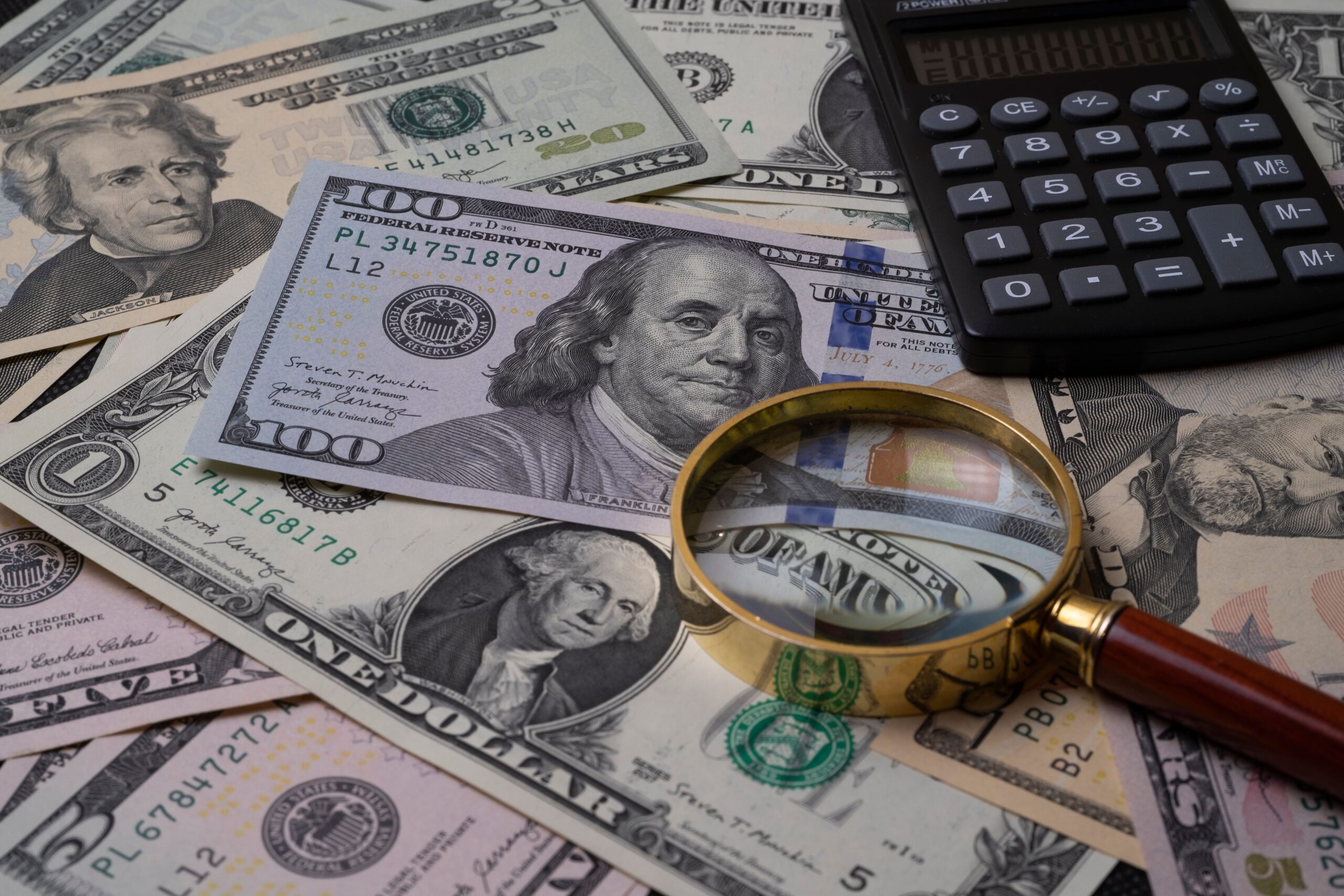
So, what is on US currency? U.S. banknotes contain a combination of visual identifiers, historical imagery, denomination markings, government symbols, serial numbers, and security features.
Federal Reserve notes commonly include a portrait on the front, a vignette or major illustration on the reverse, a Treasury seal, a Federal Reserve Bank seal, serial numbers, the series designation, denomination indicators, and specialized printing features.
The exact appearance varies by denomination and series. For example, the $5 note features Abraham Lincoln and the Lincoln Memorial, while the $10 note features Alexander Hamilton and the U.S. Treasury Building. The $20 note features Andrew Jackson and the White House, while the $100 note features Benjamin Franklin and Independence Hall.
These details are not merely decorative. Together, they help identify the denomination and authenticity of the note while reflecting elements of American history and government.
Major Things Found on U.S. Banknotes
When learning what is on US currency, the main elements to understand include:
- Historical portraits
- Buildings and national imagery
- Treasury seals
- Federal Reserve Bank seals
- Serial numbers
- Series designations
- Denomination numerals
- Raised printing
- Specialized banknote paper
- Security threads
- Watermarks on applicable denominations
- Color-shifting ink
- Microprinting and fine-line details on applicable notes
- Additional denomination-specific security features
Not every feature appears in exactly the same way on every denomination. Therefore, authentication should always be based on the correct denomination and series rather than a single universal checklist.
Why Does U.S. Currency Have So Many Features?
One reason what is on US currency matters is that genuine banknotes are designed with multiple layers of identification and security.
The U.S. Currency Education Program notes that American currency has incorporated anti-counterfeiting measures for many years. Historical designs included fine-line engraving, intricate geometric patterns, Treasury seals, and engraved signatures. Later generations introduced features such as security threads and microprinting.
Modern notes continue this approach.
Instead of depending on one feature, authentication can involve looking at several characteristics together. This is important because a suspicious note may imitate one visible characteristic while failing to reproduce other characteristics accurately.
For ordinary users, the safest principle is simple: check multiple features rather than relying on one test.
Understanding the Portraits on US Currency
One of the easiest answers to what is on US currency is the collection of historical figures displayed on U.S. banknotes.
Different denominations feature different individuals. The $5 note features Abraham Lincoln, the $10 note features Alexander Hamilton, the $20 note features Andrew Jackson, the $50 note features Ulysses S. Grant, and the $100 note features Benjamin Franklin.
The portraits are printed using detailed techniques that produce a distinctive appearance. When examining a questionable note, users can compare the portrait with an official reference image for the same denomination and series.
A portrait that looks unusually blurry, overly flat, poorly aligned, or inconsistent with an official design may deserve additional examination.
However, visual appearance alone should not be treated as conclusive proof. A genuine older or heavily circulated note can look different from a newer note.
What Buildings and Images Appear on US Currency?
Another important part of what is on US currency is the imagery on the reverse side.
U.S. banknotes use historically significant buildings and symbols. The $5 note includes the Lincoln Memorial, the $10 note includes the Treasury Building, the $20 note includes the White House, and the $100 note includes Independence Hall.
These illustrations are highly detailed and form an important part of the banknote’s visual identity.
When checking a suspicious note, compare the overall layout and major artwork with an official reference. Look for obvious differences in positioning, proportions, text, or printing quality.
Treasury Seal and Federal Reserve Bank Seal
If you are researching what is on US currency, the seals are important features to understand.
The Treasury seal appears on Federal Reserve notes and represents the U.S. Department of the Treasury. A Federal Reserve Bank seal also appears on the front of applicable notes and identifies the Federal Reserve Bank associated with the note.
These seals should have clear, detailed printing.
On a suspicious banknote, unusually poor definition, incorrect lettering, strange spacing, or an inconsistent design can be a warning sign. Again, one unusual characteristic should lead to further verification rather than an immediate conclusion.
Serial Numbers on US Currency
Serial numbers are another major answer to what is on US currency.
U.S. banknotes use combinations of letters and numbers as identifiers. For example, official information for the $5, $10, $20, and $100 notes describes unique serial-number combinations appearing on the front of the notes.
When checking a note, examine the serial numbers for:
- Clear and consistent printing
- Correct placement
- Matching appearance where applicable
- Unusual characters or spacing
- Signs of alteration or manipulation
Serial numbers should not be treated as the only authentication method. A number appearing legitimate does not automatically prove that the physical banknote is genuine.
What Is the Texture of US Currency Like?
Texture is one of the practical characteristics to consider when learning what is on US currency and how genuine notes can be examined.
Official U.S. currency information explains that Federal Reserve notes use specialized paper and raised printing. The paper is composed of cotton and linen, and genuine notes contain red and blue security fibers.
Raised printing can also give genuine notes a distinctive tactile quality.
This means a basic authentication approach can involve both looking at and feeling the note.
If a banknote feels substantially different from other genuine notes of the same denomination, it may warrant additional checking. However, wear, moisture, folding, age, and environmental conditions can change the feel of a genuine banknote.
Therefore, texture is best used together with other characteristics.
Checking Print Quality
Print quality is another useful consideration when determining what is on US currency and whether a note looks consistent with an official banknote.
Genuine currency contains intricate lines, detailed portraits, carefully positioned text, and specialized printing. Some details can appear very fine to the naked eye.
A suspicious note may display warning signs such as:
- Blurry details
- Uneven lettering
- Poorly defined fine lines
- Unusual spacing
- Misaligned elements
- Low-quality reproduction
- Printing that appears excessively flat
Modern consumer printers and digital technologies can reproduce images convincingly at a glance, which is why looking at the whole note is important.
Do not attempt to improve or reproduce any security feature. The purpose of checking these characteristics is simply to identify a note that should receive professional verification.
Watermarks on US Currency
Watermarks are another important part of what is on US currency, particularly on denominations and designs where a watermark is an applicable security feature.
A watermark is an image incorporated into the paper and can become visible when a note is viewed against a light source. Official U.S. currency information describes portrait watermarks on applicable redesigned notes.
For example, the current-style $100 note includes a portrait watermark of Benjamin Franklin.
The important point is that watermarks are not simply ordinary pictures printed on the surface.
When examining a suspicious note, compare the expected watermark for that denomination and design with an official reference.
Because older and newer series can differ, always make sure you are comparing the note with the correct official design.
Security Threads in US Currency
Security threads are among the most recognizable features when discussing what is on US currency.
A security thread is an embedded feature that runs through the paper of applicable U.S. banknotes. Depending on the denomination, it contains denomination-related text and may display a particular response under ultraviolet illumination.
The $20 note, for example, has an embedded security thread that can be viewed when the note is held to light, while official information identifies its ultraviolet response.
The important distinction is that an embedded thread is different from a line simply printed on the surface.
If a suspicious note appears to be missing an expected security thread, or the feature does not match the official characteristics for that denomination, additional verification is appropriate.
Color-Shifting Ink
Color-shifting elements are another useful part of understanding what is on US currency.
On applicable U.S. notes, certain numerals or symbols change appearance when the banknote is tilted. This effect is produced by specialized security printing.
The current-style $100 note, for example, uses color-shifting elements, including the numeral 100 and the Bell in the Inkwell. Official information states that the color changes as the note is tilted.
Color-shifting ink is valuable because it provides a feature that can be examined without specialized laboratory equipment.
However, users should not depend on this characteristic alone. A proper check should involve multiple features and, when necessary, professional verification.
The 3-D Security Ribbon on the $100 Note
If someone asks what is on US currency, the $100 note deserves special attention because it contains additional security features.
The current-style $100 note includes a blue 3-D Security Ribbon. According to the U.S. Currency Education Program, the ribbon is woven into the paper rather than simply printed on its surface. When the note is tilted, the bells and 100s appear to move.
This is a good example of why physically examining a note from different angles can reveal characteristics that are not obvious in a stationary image.
The 3-D Security Ribbon should be considered alongside the watermark, security thread, color-shifting elements, paper, and printing quality.
What Is on US Currency That Helps Prevent Counterfeiting?
The answer includes several layers of protection.
Modern U.S. banknotes combine physical, visual, and printing characteristics. These include specialized paper, raised printing, security threads, watermarks, color-shifting ink, fine details, seals, serial numbers, and denomination-specific features.
The purpose of using multiple features is to make authentication more reliable.
A suspicious note may look convincing from a distance, but a closer examination can reveal inconsistencies.
This is why cash handlers are often encouraged to know the features of the denominations they regularly handle.
How to Check a US Banknote Safely
If you are wondering how what is on US currency relates to practical banknote checking, a simple educational approach is to examine several characteristics.
1. Look
Start by examining the overall appearance.
Compare the note with an official image of the same denomination and, when relevant, the same series. Look at the portrait, major artwork, seals, denomination numbers, lettering, and serial numbers.
Obvious differences can be a reason to stop and investigate further.
2. Feel
Gently feel the banknote.
Pay attention to the paper and raised printing. Genuine Federal Reserve notes have specialized characteristics that ordinary paper may not reproduce accurately.
Do not damage, cut, wet, or otherwise alter the note while examining it.
3. Tilt
Some U.S. currency features are designed to change when the note is tilted.
Color-shifting elements and the 3-D Security Ribbon on the $100 note are examples of features that can be viewed from different angles.
4. Hold It to Light
Applicable denominations can contain watermarks and embedded security threads that become easier to see when the note is held toward a light source.
The exact feature depends on the denomination and design.
5. Compare Multiple Features
Never make an authentication decision based on only one characteristic.
For example, a note may have a convincing portrait but questionable texture. Another may have appropriate colors but an inconsistent security feature.
Multiple observations provide a more responsible basis for deciding whether professional verification is necessary.
Common Warning Signs of a Suspicious US Banknote
Understanding what is on US currency can help people recognize potential warning signs.
Common concerns may include:
- Paper that feels noticeably different
- Printing that looks blurry or unusually flat
- Missing or inconsistent security features
- A watermark that does not match the expected design
- A security thread that appears absent or inconsistent
- Color-shifting elements that do not behave as expected
- Incorrect-looking seals
- Unusual serial-number formatting
- Artwork or portraits that appear distorted
- Suspicious differences between two notes of the same denomination
None of these observations should be interpreted in isolation.
For example, a heavily worn genuine note can look unusual. Similarly, older series may have security features that differ from current designs.
That is why official reference materials are important.
Does Every US Dollar Bill Have the Same Security Features?
No.
This is one of the most important points when learning what is on US currency.
Different denominations have different designs and security characteristics. The $100 note, for example, includes features that are not necessarily present in the same form on lower denominations.
Older notes can also differ from newer designs.
The U.S. Currency Education Program documents changes in security features over time. Security threads and microprinting, for instance, were introduced during the 1990s, while redesigned denominations followed in later years.
Therefore, authentication should always consider:
Denomination + series/design + applicable security features.
Why Comparing With an Official Reference Matters
When researching what is on US currency, official reference material is more reliable than random images found online.
The U.S. Currency Education Program provides denomination-specific information about the designs and security features of U.S. Federal Reserve notes.
A useful comparison should focus on the official characteristics of the relevant denomination rather than simply asking whether the note “looks like money.”
This is especially important because genuine U.S. banknotes can vary in appearance due to age, circulation, printing series, and normal wear.
What Should You Do If a US Banknote Looks Suspicious?
If you believe a banknote may be counterfeit, do not attempt to spend it, exchange it, or pass it to another person as genuine currency.
Instead, keep the situation safe and seek guidance from an appropriate financial institution or relevant authority.
A bank, authorized financial institution, or appropriate law-enforcement authority can provide guidance about the next step. If you are handling cash in a business environment, follow your organization’s established counterfeit-note procedures.
The safest approach is to avoid confrontation and avoid making assumptions based only on appearance.
A suspicious note should be treated as something that requires verification—not as something to be tested by attempting to spend it.
What Not to Do With a Suspected Counterfeit Note
Learning what is on US currency should also include knowing what not to do.
Do not:
- Try to alter the banknote
- Attempt to repair or recreate security features
- Remove a security thread
- Change serial numbers
- Modify printing
- Try to make a suspicious note look genuine
- Pass the note to someone else as genuine
- Use it to purchase goods or services
- Sell or distribute it as legitimate currency
The purpose of banknote authentication is to protect people and businesses from financial loss and help prevent counterfeit currency from entering circulation.
Can a UV Light Confirm That a US Dollar Is Real?
Ultraviolet inspection can be useful for certain security features, but it should not be considered a complete authentication method.
Some U.S. banknotes contain security threads that exhibit specific characteristics under ultraviolet light. For example, official information describes the UV response of the $20 security thread.
However, a UV observation alone cannot establish that a note is genuine.
A responsible authentication process combines multiple features, such as texture, printing, watermark, security thread, and color-shifting characteristics where applicable.
When there is uncertainty, professional verification is the better choice.
How Businesses Can Reduce Counterfeit Currency Risk
Businesses that handle cash regularly can benefit from staff education and a clear understanding of what is on US currency.
Employees should understand what is on US currency for the denominations they commonly receive. Training can cover basic visual, tactile, and security-feature awareness, helping staff recognize important banknote characteristics without relying on a single test.
Businesses may also establish procedures for handling suspicious notes, including escalation to supervisors and appropriate financial or law-enforcement channels. Understanding what is on US currency can help employees identify features that appear inconsistent with the expected design.
Training should emphasize detection and responsible handling rather than attempting to determine authenticity through a single test. A broader knowledge of what is on US currency allows employees to compare multiple characteristics and respond appropriately when a note appears suspicious.
For higher-volume cash operations, organizations can consider appropriate commercial authentication equipment and professional procedures that comply with applicable laws and regulations.
Common Myths About US Currency
There are many misconceptions surrounding what is on US currency and how counterfeit detection works.
Myth 1: A special pen proves whether every bill is real
A detection pen is not a universal authentication solution. Different notes and counterfeit methods can produce different results, and additional security features should be considered.
Myth 2: If a bill looks old, it must be fake
Not necessarily.
Genuine currency circulates for long periods and can become worn, stained, folded, or faded.
Myth 3: Every U.S. banknote has exactly the same security features
This is incorrect.
Security characteristics vary by denomination and series.
Myth 4: A matching serial number proves authenticity
A serial number is only one component of a banknote’s identification features.
Myth 5: One test is enough
The safest approach is to use multiple observable characteristics and obtain professional verification when uncertainty remains.
What Is on US Currency? A Quick Reference
For a quick answer to what is on US currency, consider the following major categories:
| Feature | What It Does |
|---|---|
| Portrait | Identifies the historical figure associated with the denomination |
| Vignette | Shows important American buildings or imagery |
| Treasury Seal | Represents the U.S. Department of the Treasury |
| Federal Reserve Bank Seal | Identifies the issuing/distributing Federal Reserve Bank |
| Serial Numbers | Provides banknote identification information |
| Series Designation | Identifies the relevant design series |
| Raised Printing | Provides a distinctive tactile characteristic |
| Specialized Paper | Uses banknote paper with specific physical properties |
| Security Thread | Provides an embedded security characteristic on applicable notes |
| Watermark | Provides a visible image within the paper on applicable notes |
| Color-Shifting Ink | Changes appearance when viewed from different angles on applicable notes |
| 3-D Security Ribbon | Provides a dynamic security feature on the current-style $100 note |
The exact combination depends on the denomination and design.
FQs
What is on US currency?
U.S. currency includes portraits, historical buildings, Treasury and Federal Reserve identifiers, serial numbers, denomination markings, series information, specialized printing, and various security features. Different denominations have different combinations of these features.
What is printed on the front of US currency?
The front of a U.S. banknote generally contains a portrait, denomination indicators, serial numbers, seals, and other design and security elements. The exact arrangement depends on the denomination and series.
What is on the back of US currency?
The reverse side typically contains a major historical or national image along with denomination indicators and other design elements. Examples include the Lincoln Memorial on the $5 note, the Treasury Building on the $10, the White House on the $20, and Independence Hall on the $100.
What security features are on US currency?
Depending on the denomination and design, security features can include specialized paper, raised printing, security threads, watermarks, color-shifting ink, microprinting, and the 3-D Security Ribbon on the current-style $100 note.
What is the purpose of the security thread?
The security thread is an embedded security feature found in applicable U.S. banknotes. It can provide denomination-related information and may have a specific response under ultraviolet illumination.
Do all US dollar bills have watermarks?
No. Security features vary according to denomination and series. Therefore, users should check the official specifications for the particular note rather than assuming every bill has identical features.
What does color-shifting ink do?
Color-shifting ink changes appearance when a note is tilted. It is used as an authentication feature on applicable U.S. currency. The current-style $100 note, for example, uses color-shifting elements.
How can I verify a suspicious US dollar?
Start with a visual and tactile examination, compare the note against an official reference for the correct denomination and design, and examine applicable security features. If the note remains questionable, seek verification from an appropriate financial institution or authority.
Should I spend a note if I suspect it is counterfeit?
No. A suspected counterfeit note should not be passed to another person as genuine currency. Seek appropriate professional guidance instead.
Final Thoughts: Understanding What Is on US Currency
Knowing what is on US currency is more than learning the names of the people shown on American banknotes. U.S. currency combines historical imagery, government identifiers, specialized paper, detailed printing, serial numbers, and security technologies designed to support currency authentication.
The most useful lesson when learning what is on US currency is to look, feel, tilt, compare, and verify.
Look at the overall design and printing. Feel the paper and raised printing. Tilt the note to observe applicable color-shifting features. Hold it toward light to examine applicable watermarks and security threads. Then compare multiple characteristics with official information for the correct denomination and series. These steps provide a practical way to understand what is on US currency and recognize features that may require further verification.
No single visual test should be treated as an absolute guarantee. Understanding what is on US currency requires looking at several features together rather than relying on one characteristic.
If a note appears suspicious, the responsible action is not to experiment with it or attempt to use it. Instead, seek assistance from an appropriate financial institution or authority and follow applicable procedures.
For reliable information about what is on US currency, denomination-specific security features, and official banknote designs, the U.S. Currency Education Program is an authoritative reference.
Understanding the design and security features of American banknotes can help consumers and businesses make better-informed decisions while supporting safer and more responsible cash handling.

