
Counterfeit Print Lab

How to Tell If a Twenty Dollar Bill Is Fake: A Complete Guide to Spotting Counterfeit $20 Notes

In today’s fast-paced world of cash transactions, knowing how to tell if a twenty dollar bill is fake is an essential skill for business owners, cashiers, collectors, and everyday consumers. Counterfeit currency circulates more often than many people realize, and the $20 bill is one of the most commonly counterfeited denominations in the United States. Fortunately, modern U.S. banknotes include several advanced security features that make it easier to identify a genuine note. By learning a few simple checks, you can confidently detect a fake $20 bill before it causes financial loss.

How to Tell If a Twenty Dollar Bill Is Fake

The modern $20 note features the portrait of Andrew Jackson and is issued by the Federal Reserve under the authority of the United States Department of the Treasury. Each legitimate bill contains a combination of visual and tactile security elements designed specifically to prevent counterfeiting.

1. Check the Color-Shifting Ink

One of the easiest ways to verify a real $20 bill is by looking at the color-shifting ink in the lower right corner of the front side. When you tilt the bill back and forth, the number “20” should change color from copper to green. This feature is difficult for counterfeiters to replicate with ordinary printing methods.

If the number stays the same color or looks dull and flat, the bill may be counterfeit.

2. Look for the Security Thread

A genuine $20 bill includes a thin embedded security thread running vertically through the paper. Hold the bill up to a bright light and you should see a clear strip that reads “USA TWENTY” along with a small flag pattern.

Under ultraviolet (UV) light, this thread glows green, which is another powerful indicator of authenticity. Fake bills often lack this feature or print a fake thread directly onto the paper instead of embedding it.

3. Find the Watermark

Another important anti-counterfeiting feature is the watermark portrait. Hold the bill up to the light and you should see a faint image of Andrew Jackson appearing in the blank space to the right of the main portrait. The watermark is visible from both sides of the bill and should match the central portrait exactly.

If there is no watermark, or if it appears printed rather than embedded in the paper, the note may be counterfeit.

4. Feel the Raised Printing

Authentic U.S. currency uses a specialized printing process that gives the bill a distinct texture. Run your fingers over the portrait and lettering—you should feel slightly raised ink.

Counterfeit money often feels smooth, thin, or similar to ordinary printer paper. Real banknotes are printed on a durable blend of cotton and linen, giving them a unique, crisp feel.

5. Examine Microprinting Details

Real $20 bills contain tiny text that is extremely difficult to replicate without professional equipment. Use a magnifying glass and look for microprinting around the portrait and security areas. For example, very small text reading “USA20” or “THE UNITED STATES OF AMERICA” may appear in specific locations.
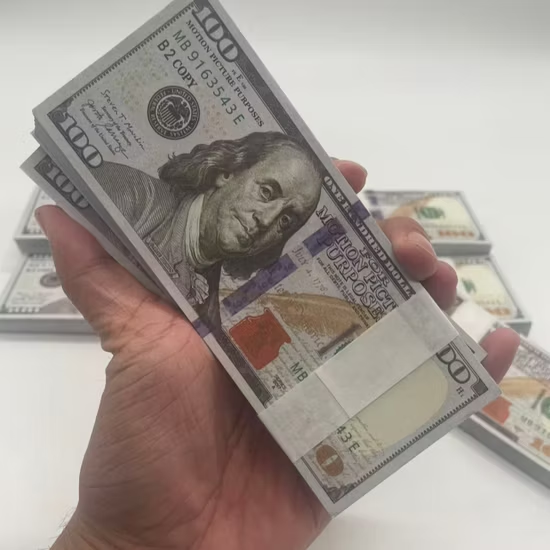
How to Tell If a Twenty Dollar Bill Is Fake

On fake bills, these details often look blurry, smudged, or like simple lines instead of readable text.

6. Inspect the Overall Design

Finally, pay attention to the overall quality of the printing. Authentic bills have sharp lines, precise borders, and balanced coloring. Blurry portraits, misaligned printing, or unusual coloring can signal a counterfeit.

Stay Protected from Counterfeit Currency

Learning how to detect a fake twenty dollar bill is a valuable skill that helps protect both consumers and businesses. By checking the color-shifting ink, security thread, watermark, raised printing, and microprinting, you can quickly confirm whether a $20 bill is genuine.

Whether you handle cash daily or only occasionally, understanding these $20 bill security features will help you avoid counterfeit money and ensure every transaction is safe and legitimate.
How to Tell If a Twenty Dollar Bill Is Fake

Counterfeit money continues to circulate in many parts of the world, and the $20 bill is one of the most commonly counterfeited U.S. banknotes. Whether you own a retail store, receive cash payments, or simply want to protect yourself, knowing how to tell if a twenty dollar bill is fake can save you from financial loss.

The good news is that modern U.S. currency includes several advanced security features that are difficult for counterfeiters to copy. Most fake bills can be identified within a few seconds if you know what to look for.

How to Tell If a Twenty Dollar Bill Is Fake

In this guide, you’ll learn the easiest and most reliable ways to identify a genuine $20 bill.

Why Are Twenty Dollar Bills Frequently Counterfeited?

The $20 bill is widely used for everyday purchases. Since it changes hands so often, counterfeiters target it because fake bills are less likely to receive close inspection than larger denominations like $100 bills.

Businesses, gas stations, restaurants, and convenience stores are especially common targets.

Feel the Paper Texture

The first thing to check is the paper.

Real U.S. currency is not printed on regular paper. It is made from a special blend of:

  • 75% cotton
  • 25% linen

A genuine $20 bill feels crisp, firm, and slightly rough.

Counterfeit bills often feel:

  • Smooth
  • Waxy
  • Too soft
  • Like printer paper

If the bill feels unusual, inspect it more closely.

Look for Raised Printing

Authentic $20 bills use intaglio printing, which creates raised ink that you can feel.

Run your finger across:

  • Andrew Jackson’s portrait
  • The words “United States of America”
  • The large denomination numbers

Real bills have noticeable texture.

Many counterfeit bills feel completely flat because standard printers cannot reproduce raised ink.

Check the Security Thread

Hold the bill up to a light.

A genuine $20 bill contains a vertical security thread embedded inside the paper.

The strip should display:

  • USA
  • TWENTY

repeated along the thread.

Under UV light, the thread glows green, which is one of the easiest ways to verify authenticity.

If no thread appears, the bill is almost certainly fake.

Find the Watermark

A genuine $20 bill includes a watermark of Andrew Jackson.

Hold the bill toward a bright light.

You should see the watermark on the blank space to the right of the portrait.

The watermark:

  • Is visible from both sides
  • Matches the printed portrait
  • Cannot simply be printed onto the surface

Fake bills often have blurry or missing watermarks.

Examine the Color-Shifting Ink

Newer $20 bills feature color-changing ink.

Tilt the bill.

The number 20 in the lower-right corner should change from:

  • Copper
  • Green

depending on the viewing angle.

Counterfeit bills usually use ordinary ink that never changes color.

Inspect the Microprinting

Microprinting is extremely small text that most counterfeit printers cannot duplicate.

Use a magnifying glass if needed.

Look around:

  • The portrait
  • Security ribbon
  • Borders

The tiny letters should appear sharp and readable.

On fake bills, microprinting often looks blurry or like a solid line.

Compare the Portrait

Andrew Jackson’s portrait should appear:

  • Sharp
  • Highly detailed
  • Well-defined

Fake bills often have:

  • Blurry facial features
  • Thick lines
  • Poor shading
  • Low-quality printing

Comparing the bill with another genuine $20 bill can make differences easier to spot.

Check the Serial Numbers

Every genuine bill has matching serial numbers printed twice.

Make sure:

  • Both numbers match
  • The spacing is even
  • The ink color is consistent

Counterfeit bills sometimes show:

  • Different serial numbers
  • Uneven alignment
  • Crooked printing
  • Duplicate serial numbers

Look for Fine Printing Details

Authentic U.S. currency contains extremely fine lines and detailed engraving.

Pay close attention to:

  • Borders
  • Treasury seal
  • Federal Reserve seal
  • Background patterns

Counterfeit bills frequently have:

  • Smudged lines
  • Broken patterns
  • Pixelated images
  • Uneven borders

The sharper the printing, the more likely the bill is genuine.

Use a UV Light or Counterfeit Detector

Businesses often use counterfeit detection tools for extra security.

Popular options include:

  • UV lights
  • Counterfeit detector pens
  • Currency scanners
  • Automatic cash counters with verification

While detector pens can help, they are not foolproof because some counterfeit bills use paper that reacts similarly to genuine currency.

Combining multiple security checks always provides the most reliable results.

Common Signs of a Fake $20 Bill

Here are some quick warning signs:

  • Missing security thread
  • No watermark
  • Flat printing
  • Smooth paper texture
  • Blurry portrait
  • Incorrect colors
  • Poor-quality borders
  • Color that does not shift
  • Uneven serial numbers
  • Misspelled words

If several of these signs appear, avoid accepting the bill.

What Should You Do If You Receive a Fake Bill?

If you believe a $20 bill is counterfeit:

  • Do not spend it.
  • Avoid returning it to the person if doing so could create a confrontation.
  • Note where and when you received it.
  • Contact your local law enforcement agency or bank.
  • Follow any instructions provided by authorities for handling suspected counterfeit currency.

Trying to pass a counterfeit bill—even unknowingly after discovering it may be fake—can create legal complications.

Tips to Avoid Accepting Counterfeit Money

You can reduce your risk by following a few simple habits:

  • Check every large cash payment.
  • Compare suspicious bills with one you know is genuine.
  • Keep a UV flashlight at your register.
  • Train employees to recognize security features.
  • Stay familiar with the latest U.S. currency designs.

A quick inspection takes only a few seconds and can prevent costly mistakes.

Final Thoughts

Knowing how to tell if a twenty dollar bill is fake is an essential skill for anyone who handles cash. By checking the paper texture, raised printing, watermark, security thread, color-shifting ink, microprinting, and serial numbers, you can identify most counterfeit bills quickly and confidently.

No single feature should be relied on by itself. The safest approach is to verify several security features together. With a little practice, spotting a suspicious $20 bill becomes much easier, helping you protect yourself and your business from counterfeit currency.

How can I tell if a $20 bill is fake without a machine?

Check the paper texture, raised printing, watermark, security thread, color-shifting ink, and serial numbers. These features can usually be inspected by hand and under a bright light.

Does every genuine $20 bill have a watermark?

Modern redesigned $20 bills do. Older series may have different security features depending on the year they were issued.

Do counterfeit detector pens always work?

No. They can identify some fake bills but are not completely reliable. It’s best to combine them with visual and tactile security checks.

What color should the security thread glow?

On a genuine modern U.S. $20 bill, the embedded security thread glows green under ultraviolet (UV) light.

What should I do if I accidentally receive a counterfeit bill?

Do not try to use it. Contact your bank or local law enforcement for guidance and report where you received the bill.

Leave a Comment

Your email address will not be published. Required fields are marked *

EnglishenEnglishEnglish
Scroll to Top