
Debit cards have become a normal part of everyday life. People use them to buy groceries, pay bills, shop online, withdraw cash, and make contactless payments. Because debit cards are connected directly to bank accounts, card security is an important concern for almost every cardholder.
One question that often comes up is, can a debit card chip be cloned? The short answer is that modern EMV chip technology is specifically designed to make traditional counterfeit-card fraud much more difficult. However, that does not mean debit cards are completely protected from every form of fraud.
It is important to understand the difference between copying card information and actually duplicating the security functions of an EMV chip. Someone may obtain payment-card information without successfully creating a working duplicate of the original chip.
Modern payment security also uses several layers of protection. These can include chip technology, transaction monitoring, authentication systems, fraud detection, encryption, and alerts from banks.
In this guide, we will explain how debit card chips work, what people usually mean when they talk about card cloning, why EMV cards are more difficult to counterfeit, and what you can do if you think your card information has been compromised.
Can a Debit Card Chip Be Cloned?
The question can a debit card chip be cloned does not have a simple yes-or-no answer because the word “cloned” can mean different things.
A person might use the word cloning to describe copying information from a payment card. Someone else might use it to mean creating a counterfeit physical card. These are not necessarily the same thing.
An EMV chip is more than a storage area containing your card number. It is a small computer that participates in the payment process. During a chip transaction, the payment system can use security information that is different from transaction to transaction.
This makes EMV technology much harder to reproduce than the older magnetic stripe system. Simply knowing the card number does not mean someone has reproduced the security capabilities of the chip.
That distinction is important because stolen card information can still create risks even when the physical chip has not been duplicated.
For example, criminals may attempt to use stolen payment details for unauthorized purchases. This can happen through different types of payment fraud, including card-not-present transactions.
The good news is that EMV technology was created to reduce certain types of counterfeit-card fraud. It does not make fraud impossible, but it adds an important layer of security.
If you notice suspicious activity on your debit card, you should not assume that your physical chip has been cloned. The problem could involve stolen card details, account credentials, unauthorized transactions, or another type of fraud.
The safest response is to contact your bank or card issuer and follow its official fraud-reporting process.
What Does Debit Card Cloning Mean?
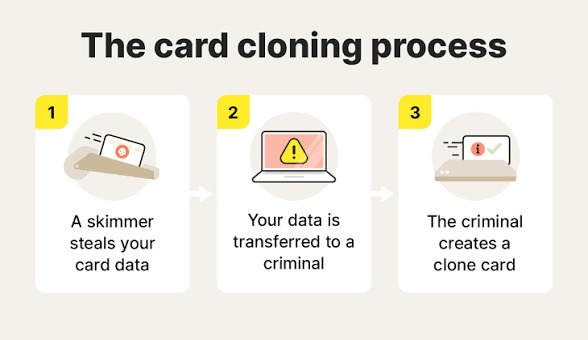
Debit card cloning is a general term used to describe the unauthorized copying or reproduction of payment-card information.
The term is often used broadly on the internet, which can confuse. People sometimes use “cloning” to describe any situation where someone obtains card information and uses it without permission.
In reality, several different forms of payment fraud exist.
One situation involves stolen card information. Another involves unauthorized online purchases. A different situation may involve counterfeit physical cards. Account takeover is another separate security problem.
These situations can have different causes and require different security responses.
For a consumer, the most important point is that seeing an unauthorized transaction does not automatically prove that someone duplicated the card’s EMV chip.
Your card information might have been exposed through an online account, a compromised merchant, a phishing message, a data breach, or another security problem.
This is why it is better to focus on protecting your account rather than trying to determine exactly how someone obtained the information.
If your bank detects unusual activity, it may ask you to confirm transactions. It may also temporarily restrict the card or recommend replacing it.
These measures are designed to limit additional unauthorized activity.
Is Copying Card Information the Same as Cloning the Chip?
No. Copying card information and duplicating an EMV chip are different concepts.
A debit card contains information that helps identify the payment account. Some of that information may appear on the card itself, while other security information is handled through the chip and payment system.
If someone obtains basic card details, they may have enough information to attempt certain unauthorized transactions. That does not mean they have successfully reproduced the original chip.
The EMV chip performs security-related functions during supported transactions. It can generate transaction-specific information that helps the payment network determine whether a transaction is legitimate.
This is one of the reasons chip cards are more resistant to certain types of counterfeit fraud.
It is also why consumers should not assume that protecting only the physical card is enough.
Your card number, security code, banking password, email account, and other credentials can all be important parts of your overall financial security.
A strong security strategy protects the entire account rather than focusing on one technology.
How Does a Debit Card Chip Work?
A modern debit card with an EMV chip contains a small integrated circuit.
EMV stands for Europay, Mastercard, and Visa. It refers to a global standard used for chip-based payment cards and compatible payment systems.
The chip can communicate with a compatible payment terminal during a transaction.
Instead of simply providing the same information every time, the chip can participate in a transaction using security mechanisms designed to help authenticate the payment.
One important concept is dynamic transaction information.
In simple terms, this means that information used to support a transaction can be linked to that particular transaction rather than functioning like a simple permanent code.
This design makes certain forms of counterfeit fraud more difficult.
The payment terminal, card, payment network, and bank can work together to process the transaction and evaluate its security.
The exact process depends on the card, issuer, payment network, terminal, and transaction type.
Consumers do not need to understand every technical detail to benefit from the technology.
The important point is that an EMV chip is not simply a magnetic stripe stored inside a smaller package.
It has processing capabilities that are part of the payment security system.
Chip Cards vs. Magnetic Stripe Cards
Older magnetic stripe cards work differently from modern EMV chip cards.
A magnetic stripe stores payment information that can be read by compatible card readers. Historically, counterfeit-card fraud was a significant concern because information from a magnetic stripe could be copied and reproduced more easily.
EMV chips were developed to improve payment security and reduce certain forms of counterfeit fraud.
Here is a simple comparison:
| Feature | Magnetic Stripe | EMV Chip |
|---|---|---|
| Basic technology | Magnetic data storage | Integrated circuit |
| Transaction security | More limited | Stronger security mechanisms |
| Dynamic transaction information | Generally not used in the same way | Supported |
| Counterfeit resistance | Lower | Higher |
| Online transaction protection | Separate security process | Separate security process |
| Fraud protection | Limited to available controls | Multiple security layers |
This does not mean magnetic stripes are automatically unsafe or that EMV cards can never be involved in fraud.
Instead, it means that EMV technology provides additional protection against certain types of counterfeit transactions.
Why Are EMV Chips Harder to Counterfeit?
One of the main advantages of EMV technology is its ability to participate actively in a payment transaction.
A magnetic stripe primarily provides stored information. An EMV chip can perform processing and security functions.
The chip can help create transaction-specific information and support authentication.
This creates an important difference between copying information and reproducing the behavior of a legitimate chip.
Even if someone obtains some information associated with a card, that information may not be sufficient to recreate everything needed for a genuine chip transaction.
Payment systems can also use other security measures alongside the chip.
Banks and payment networks may monitor transactions for unusual activity. They can consider patterns such as spending behavior, transaction location, frequency, and other risk signals.
These systems are not perfect, but together they create multiple layers of protection.
This layered approach is one of the reasons consumers should use every security feature available from their financial institution.
Can Someone Copy the Information From a Debit Card?
Payment-card information can potentially be exposed in several ways.
For example, criminals may attempt to obtain information through phishing scams, fake websites, compromised businesses, data breaches, malicious messages, or other fraudulent activity.
This is different from successfully cloning an EMV chip.
A cardholder may therefore experience unauthorized activity even though the physical card remains in their wallet.
This is especially important for online shopping.
An online transaction does not involve physically inserting your debit card’s EMV chip into a payment terminal.
Instead, the transaction uses other methods of authentication and fraud protection.
As a result, having a chip card does not mean every type of payment fraud disappears.
This is why consumers should protect their card information even when they rarely use their physical card.
Never share payment information with someone simply because they claim to be calling from your bank.
Banks and legitimate companies have established procedures for handling account security issues. If you receive a suspicious message, contact your bank through an official channel rather than using a phone number or link provided in the suspicious message.
What Information Should You Protect?
Your debit card contains several pieces of information that should be treated carefully.
Your card number is sensitive financial information. The expiration date and security code may also be used in certain transactions.
Your PIN is especially important because it is used to authenticate certain types of card activity.
You should never share your PIN with another person.
Your online banking username and password also require strong protection. If someone gains access to your banking account, the risk can extend beyond the physical debit card.
Your email account can also be important because financial services may send password-reset messages and security notifications there.
For these reasons, financial security is broader than protecting the plastic card itself.
A secure account requires good habits across your devices, passwords, email accounts, banking apps, and payment information.
What Is Card-Not-Present Fraud?
Card-not-present fraud occurs when a payment is attempted without physically presenting the card to a payment terminal.
Online shopping is a common example.
The customer may enter payment information into a website or app instead of inserting or tapping the physical card.
This type of transaction has a different security model from a chip-and-PIN transaction at a physical store.
The EMV chip cannot physically participate in an online transaction because the card is not being inserted into a payment terminal.
Other security technologies may therefore be used.
These can include authentication systems, fraud monitoring, verification processes, and risk-based transaction checks.
This explains why a person can have a secure EMV card and still experience online payment fraud.
Consumers should therefore monitor both physical and online transactions.
Can a Contactless Debit Card Be Cloned?
Contactless debit cards use near-field communication, commonly known as NFC, to communicate with compatible payment terminals.
The card can be tapped near the terminal instead of being inserted.
Contactless payment technology also uses security mechanisms designed to protect transactions.
A common misconception is that simply being close to a contactless card means someone can automatically obtain everything needed to make fraudulent payments.
The reality is more complicated.
Contactless payments are designed with security controls, and payment networks use multiple systems to reduce fraud.
However, no payment technology should be considered completely risk-free.
If your card is lost, stolen, or associated with suspicious transactions, contact your card issuer.
Your bank can explain what happened and tell you whether the card should be blocked or replaced.
Is Tap-to-Pay Safe?
Tap-to-pay has become increasingly common because it is fast and convenient.
For supported transactions, the payment card communicates with the terminal using contactless technology.
Security protections can help reduce unauthorized use.
However, consumers should still follow basic payment-security practices.
Keep your card secure and avoid lending it to other people.
Use transaction notifications if your bank offers them.
Check your account regularly.
If you see a transaction you do not recognize, contact your financial institution promptly.
The goal is not to become afraid of contactless payments.
Instead, consumers should understand that contactless technology is one part of a broader payment-security system.
Common Myths About Debit Card Chip Cloning
There are many misleading claims about debit card chips online.
Understanding the facts can help consumers avoid unnecessary fear.
Anyone Can Easily Copy an EMV Chip
This statement is an oversimplification.
EMV chips are designed with security mechanisms that make certain forms of counterfeit-card fraud more difficult.
Copying some card information is not necessarily the same as reproducing the chip’s security functions.
If Someone Knows My Card Number, My Chip Has Been Cloned
Knowing your card number does not automatically mean someone has duplicated your physical EMV chip.
A stolen card number can still be dangerous, especially if it is used for unauthorized transactions.
However, that is different from successfully reproducing the chip.
Chip Cards Make Fraud Impossible
EMV technology improves security, but no payment system eliminates every possible form of fraud.
Phishing, stolen credentials, data breaches, account takeover, and card-not-present fraud can still create risks.
Contactless Cards Are Automatically Unsafe
Contactless cards use security technologies designed to protect transactions.
Consumers should still protect their cards and monitor their accounts, but there is no reason to assume that every contactless transaction is automatically dangerous.
An Unfamiliar Transaction Always Means the Chip Was Cloned
An unfamiliar transaction can have many possible explanations.
It could involve a forgotten subscription, a merchant using a different billing name, stolen card details, an account problem, or genuine unauthorized activity.
The safest approach is to review the transaction and contact the bank if you do not recognize it.
Warning Signs That Your Debit Card Information May Be Compromised
One of the best ways to protect your finances is to notice suspicious activity quickly.
An unfamiliar transaction is one of the clearest warning signs.
Pay attention to small transactions as well as large ones.
Unexpected payment notifications can also indicate that something needs attention.
You should also take unexpected password-reset messages, account alerts, or banking notifications seriously.
Another warning sign is a sudden decline in transactions that normally work.
Your bank may block a transaction because its fraud-detection system identifies unusual activity.
You might also receive a message from your financial institution asking you to verify a transaction.
However, remember that criminals can create fake security messages too.
Do not automatically click a link in a suspicious email or text message.
Instead, contact your bank through its official website, official mobile application, or the telephone number printed on your card.
What Should You Do If You Suspect Debit Card Fraud?
If you see an unauthorized debit-card transaction, act quickly.
Start by contacting your bank or card issuer.
Explain that you do not recognize the transaction and ask what steps you should take.
If your banking app has a card-lock or card-freeze feature, you may be able to use it while you contact the bank.
Review recent transactions carefully.
Sometimes unauthorized activity involves more than one transaction.
You should also check whether your account information or contact details have changed unexpectedly.
If the bank determines that your card may have been compromised, it may recommend replacing it.
Follow the bank’s official instructions rather than trying to investigate the suspected fraud yourself.
If you believe your online banking credentials may also be exposed, ask the bank about securing your account.
Keep records of suspicious transactions and communications with the financial institution.
Prompt reporting can help limit additional problems and may make the investigation easier.
Should You Cancel a Debit Card If You See Suspicious Activity?
There is no single answer for every situation.
Your bank or card issuer can determine whether the card should be blocked, replaced, or kept active.
If unauthorized activity is confirmed, the bank may recommend replacing the card.
Some banks also provide temporary card-lock features through their mobile apps.
These features can be useful when you are unsure where your card is or when you notice suspicious activity.
However, a temporary lock is not necessarily a substitute for reporting suspected fraud.
If you believe someone has accessed your account or payment information, contact the financial institution and follow its guidance.
How to Protect Your Debit Card From Fraud
Good security habits can significantly reduce unnecessary risk.
Start by monitoring your account regularly.
Many banks offer transaction notifications through mobile applications, text messages, or email.
These alerts can help you identify unfamiliar activity quickly.
Protect your PIN.
Do not share it with friends, strangers, callers, or people claiming to represent your bank.
When entering your PIN at a payment terminal or ATM, shield the keypad from people nearby.
You should also protect your online banking password.
Use a strong and unique password instead of using the same password across multiple accounts.
If your bank supports multi-factor authentication, consider enabling it.
Multi-factor authentication adds another security layer to the account.
You should also keep your banking application and operating system updated.
Security updates can address vulnerabilities and improve protection.
Be careful with messages that create a sense of urgency.
A scammer might claim that your bank account will be closed unless you immediately click a link.
Instead of responding directly, open your bank’s official app or website independently.
Protect Your PIN
Your PIN should be treated as private information.
Never write it directly on your debit card.
Do not send it through text messages or social media.
Do not tell someone your PIN because they claim they need it to “verify” your account.
Legitimate bank employees generally have established security procedures and should not need you to disclose sensitive credentials through suspicious communication.
When using an ATM or payment terminal, check your surroundings.
If someone is standing unusually close, wait until you have enough privacy.
These simple habits can help protect your account.
Use Banking Alerts
Banking alerts are one of the easiest security features to use.
Many financial institutions allow customers to receive notifications when a transaction occurs.
Some banks offer additional alerts for withdrawals, transfers, login attempts, or account changes.
These notifications can help you recognize suspicious activity sooner.
For example, if you receive a transaction alert while your card is safely in your wallet, you can investigate the transaction immediately.
Fast awareness does not guarantee that fraud will never happen.
However, it can reduce the amount of time an unauthorized transaction goes unnoticed.
How Banks Detect Debit Card Fraud
Banks use different systems to identify suspicious transactions.
These systems can examine transaction patterns and other risk indicators.
For example, an unusual purchase may receive additional scrutiny if it does not match the account’s normal activity.
Banks may also consider transaction frequency, location, merchant information, and other signals.
Automated systems can sometimes block a transaction or request additional verification.
These systems are not perfect.
A legitimate transaction can occasionally be declined because it looks unusual.
Likewise, fraudulent activity may sometimes pass through automated systems.
That is why consumers remain an important part of the security process.
Regular account monitoring helps identify activity that automated systems may not immediately flag.
Why a Suspicious Transaction May Be Blocked
Have you ever tried to use your debit card and had a transaction declined unexpectedly?
One possible reason is fraud prevention.
Banks may temporarily block transactions when their systems identify unusual behavior.
This does not always mean fraud has occurred.
Traveling to a new location, making an unusually large purchase, or using a new merchant can sometimes trigger security checks.
If your legitimate transaction is declined, follow the instructions provided by your bank.
Never share your PIN, password, or security code with an unknown person who contacts you claiming they can “unlock” your card.
Use official bank communication channels instead.
EMV Security Is Strong, But It Is Not Perfect
It is useful to have realistic expectations about payment security.
EMV technology provides important protection against certain types of counterfeit-card fraud.
However, it does not protect every part of the payment ecosystem.
This works well in your fraud-prevention section. The FTC provides consumer guidance about scams, identity theft, and protecting personal information.
Visit the FTC Consumer Advice Center
For example, phishing attacks can target customers directly.
A data breach can expose information held by a company.
Online fraud can occur without the physical card being present.
Account takeover can also create serious problems.
This is why payment security should be viewed as a layered system.
The EMV chip is one layer.
Bank fraud monitoring is another.
Secure online accounts, strong passwords, authentication tools, transaction alerts, and responsible consumer behavior add additional layers.
No single feature should be expected to provide complete protection.
Debit Card Chip Security vs. Magnetic Stripe Security
The move from magnetic stripes to EMV chips represented an important change in payment security.
Magnetic stripes generally contain static payment information.
EMV chips can participate in transactions using stronger security mechanisms.
This difference makes certain forms of counterfeit-card fraud more difficult.
However, both technologies exist within a larger payment ecosystem.
A consumer may still face risks from stolen credentials, online fraud, scams, compromised accounts, and other security problems.
The following summary can help explain the difference:
| Security Area | Magnetic Stripe | EMV Chip |
|---|---|---|
| Data storage | Static information | Chip-based processing |
| Counterfeit resistance | Lower | Higher |
| Transaction security | More limited | Stronger mechanisms |
| Dynamic transaction information | Limited | Supported |
| Online fraud protection | Separate controls | Separate controls |
| Consumer monitoring | Important | Important |
The main lesson is simple: an EMV chip improves security, but responsible account management is still necessary.
What About Debit Card Skimming?
Skimming is a type of payment fraud in which criminals attempt to capture payment information through compromised or fraudulent payment equipment.
The important thing for consumers to understand is that skimming and EMV chip cloning are not necessarily the same thing.
Different payment environments can have different security risks.
Consumers should therefore be cautious when using unfamiliar payment terminals or ATMs.
If a payment terminal looks damaged, unusual, or different from the surrounding equipment, consider using another trusted terminal.
At an ATM, protect your PIN and pay attention to unexpected devices or changes.
If you believe an ATM or terminal may have been compromised, notify the relevant bank or business.
The goal is to recognize potential risks without attempting to inspect or manipulate suspicious equipment yourself.
How Online Shopping Affects Debit Card Security
Online shopping creates a different payment environment from a physical store.
When you shop online, your physical EMV chip does not participate in the same way it does during an in-person chip transaction.
The website or app may use other security technologies.
Consumers should therefore pay attention to the websites they use for purchases.
Avoid entering payment information into websites that appear suspicious.
Check the website address carefully.
Be especially cautious about links received through unexpected emails, social media messages, or text messages.
Scammers often create websites that look similar to legitimate businesses.
If you are unsure about a website, access the company through an official source rather than following an unexpected link.
How Phishing Can Affect Debit Card Security
Phishing is a form of fraud designed to trick people into revealing sensitive information.
A phishing message might claim that there is a problem with your bank account.
It may ask you to confirm your card information, password, or other credentials.
Some messages create urgency by saying that your account will be closed unless you respond immediately.
Do not allow urgency to override good security habits.
If a message claims to come from your bank, contact the bank through its official website or application.
Do not use contact information supplied in a suspicious message.
Remember that banks and payment companies have formal security processes.
Being cautious with unexpected messages is one of the simplest ways to protect your financial information.
How Data Breaches Can Affect Debit Card Security
Businesses sometimes experience data breaches in which unauthorized parties gain access to information stored in their systems.
A breach does not necessarily mean that every customer’s debit card chip has been cloned.
However, exposed information can potentially create risks.
If a company you use announces a security incident, pay attention to its official instructions.
Monitor your financial accounts for unusual activity.
Change passwords when appropriate, especially if you reused the same password on multiple websites.
Remember that a compromised online account can create risks beyond payment-card information.
This is another reason to use unique passwords and multi-factor authentication whenever possible.
Can a Bank Tell If a Debit Card Has Been Compromised?
Banks use fraud-monitoring systems and other security tools to identify suspicious activity.
However, there is no universal method that can instantly determine the exact cause of every unauthorized transaction.
A bank may be able to identify unusual transaction patterns.
It may also investigate reports from customers.
If you notice suspicious activity, provide the bank with accurate information about the transaction.
Do not guess about how the information may have been stolen.
Simply explain what you recognize and what you do not recognize.
The bank can then determine the appropriate next steps.
What Should You Never Do After Suspecting Card Fraud?
You should never try to confront someone you believe may be responsible for unauthorized transactions.
Do not attempt to investigate suspicious payment equipment yourself.
Do not publish your card number, account number, PIN, or other sensitive information online while asking strangers for help.
Do not give your security credentials to people who contact you unexpectedly.
Instead, use official channels.
Your bank has established procedures for investigating suspected fraud.
Following those procedures is safer and more effective than attempting to solve the problem independently.
FAQ :
Can a debit card chip be cloned?
Modern EMV chips are designed to make certain types of counterfeit-card fraud difficult. Copying card information is not necessarily the same as duplicating the security functions of an EMV chip.
Can someone use my debit card without having the physical card?
Yes, unauthorized transactions can occur without the physical card being present. For example, stolen payment information may potentially be used for certain online or card-not-present transactions.
Is an EMV chip safer than a magnetic stripe?
EMV technology provides stronger protection against certain forms of counterfeit-card fraud because the chip can participate in transactions using dynamic security information.
Does an EMV chip make my debit card completely safe?
No. EMV improves security but does not eliminate phishing, account takeover, data breaches, card-not-present fraud, or every other type of financial crime.
Can someone clone a contactless debit card?
Contactless payment technology includes security mechanisms designed to protect transactions. Consumers should still protect their cards, monitor their accounts, and report suspicious activity.
What should I do if I see an unfamiliar debit-card transaction?
Contact your bank or card issuer promptly. If available, use your bank’s card-lock feature while following the bank’s official instructions for reporting unauthorized activity.
Should I replace my debit card if I think the information was stolen?
Contact your bank and explain the situation. The bank can determine whether the card should be blocked or replaced.
Does knowing my debit card number mean someone has cloned my card?
No. Knowing card details is different from successfully duplicating the security functions of an EMV chip.
Are online purchases protected by the physical chip?
Online transactions generally do not involve physically inserting the EMV chip into a payment terminal. They use other authentication and fraud-prevention systems.
How can I protect my debit card?
Monitor your account, enable transaction alerts, protect your PIN, use strong passwords, enable multi-factor authentication where available, avoid suspicious links, and report unauthorized activity quickly.
Final Thoughts :
So, can a debit card chip be cloned? The answer depends on what is meant by “cloned.” Modern EMV chips are designed to make traditional counterfeit-card fraud much more difficult because the chip can participate in transactions using security mechanisms that are not simply the same as copying visible card information.
However, EMV technology does not make a debit card completely immune to fraud. Stolen card details, phishing, online scams, compromised accounts, data breaches, and card-not-present transactions can still create risks.
The best approach is to use several layers of protection at the same time. Keep your debit card secure, protect your PIN, use strong account credentials, enable banking alerts, monitor transactions, and contact your financial institution quickly when something looks wrong.
Understanding the difference between card-data theft and actual chip duplication can also help you avoid unnecessary confusion. If you ever suspect that your debit card information has been compromised, you do not need to determine exactly how it happened. Your bank can investigate the situation and tell you what to do next.

