
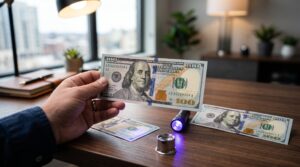
Counterfeit money is a serious problem for businesses, cashiers, shop owners, and everyday consumers. A fake bill may look real at first glance, but accepting it can lead to direct financial loss. In most cases, if you unknowingly accept counterfeit money, you may not be able to recover the value of that bill. That means a small mistake at the checkout counter can become a real loss for a store, restaurant, delivery worker, or individual seller.
This is why it is important to understand how to know counterfeit money before accepting cash. You do not need to be a bank expert to notice warning signs. Many genuine bills include security features that are designed to help ordinary people check them quickly. For example, the U.S. Currency Education Program teaches a simple method: feel the paper, tilt the note, and check it with light. These steps help people identify important security features in genuine U.S. currency.
Fake bills can enter circulation in many places, including stores, marketplaces, private sales, taxis, restaurants, and busy retail counters. Counterfeiters often depend on speed, distraction, and low lighting. They may try to pass fake money during rush hours or when staff members are too busy to check carefully. This is why a simple cash-checking habit can protect you.
In this guide, you will learn how to identify counterfeit money by checking the feel, watermark, security thread, color-shifting ink, serial numbers, printing quality, and other warning signs. You will also learn what to do if you receive a suspicious bill and how businesses can reduce the risk of accepting fake money.
What Is Counterfeit Money?
Counterfeit money is fake currency made to look like real money. It is created without legal authority and is designed to deceive people into accepting it as genuine cash. In simple words, counterfeit bills are fake bills that copy the appearance of real banknotes.
A counterfeit bill may copy the color, size, portrait, serial number, and design of a real note. However, fake bills usually fail when you inspect the security features closely. Genuine currency is produced using special materials, printing methods, and security details. These features are difficult to copy perfectly.
Counterfeit money can be made in different quality levels. Some fake bills are very poor and easy to detect. They may feel like ordinary paper, have blurry printing, or show incorrect colors. Other counterfeit bills can look more convincing, especially if someone only checks them quickly. That is why it is important to use more than one method when checking a bill.
The goal is not to panic every time you handle cash. The goal is to build a simple habit. When you receive a bill, especially a larger denomination, take a moment to feel it, look at it, tilt it, and check it against known security features. This quick process can help you avoid many common fake bills.
Why It Is Important to Identify Counterfeit Money
Knowing how to know counterfeit money is important because counterfeit bills can cause several problems. The most obvious problem is financial loss. If a shop owner accepts a fake bill, the business loses the product or service given in exchange for that bill. The fake bill itself has no real value.
The Federal Reserve explains that if you end up with a counterfeit note, you will lose that money. This makes counterfeit detection important for anyone who handles cash.
Counterfeit money can also create legal and operational problems. If a suspicious bill is discovered later, the person or business may need to report it, document the situation, and cooperate with the bank or proper authority. For businesses, this takes time and can create stress for employees.
There is also a customer-service risk. Cashiers must handle suspicious bills carefully. Accusing a customer directly can lead to conflict, especially if the customer received the bill unknowingly. A calm and professional process helps protect the business while avoiding unnecessary confrontation.
For businesses, fake bills can affect daily cash balancing. One counterfeit bill can create confusion in the register, cause accounting differences, and reduce profit. If a business handles many cash transactions every day, even occasional counterfeit bills can become a recurring loss.
For individuals, counterfeit money can be a problem during private sales. For example, someone selling a phone, bicycle, appliance, or used item may accept cash without checking it properly. If the bill is fake, the seller loses both the item and the money.
This is why counterfeit detection is not only for banks. It matters for retail workers, small business owners, delivery drivers, market sellers, event vendors, taxi drivers, and anyone who receives cash payments.
How to Know Counterfeit Money by Touch
One of the first ways to identify counterfeit money is by touch. Genuine money usually has a distinct texture. It often feels different from regular printer paper. The exact feel depends on the country and type of currency, but real banknotes are generally made with special materials and printing processes.
For U.S. currency, official education materials recommend starting with the “feel” test. Genuine notes have a unique paper feel and raised printing that can often be felt by touch.
When checking a bill by touch, pay attention to the paper quality. A real bill should not feel like ordinary office paper. It should not feel too waxy, too smooth, too thin, or too soft. Fake bills are often printed on lower-quality paper, and this can make them feel wrong.
Raised printing is another important sign. On many genuine bills, certain printed areas may feel slightly raised or textured. This happens because of the printing process used for real currency. Counterfeit bills may look similar from a distance but feel flat when you rub your finger across the surface.
You should also check thickness. A suspicious bill may feel unusually thick or unusually thin. Some counterfeiters try to copy security features by gluing or layering paper. This can make the bill feel heavier or stiffer than normal. Others use low-quality paper that feels weak or limp.
A good habit is to compare the suspicious bill with another bill of the same denomination that you know is genuine. Feel both bills side by side. Look for differences in texture, stiffness, and printing. If one bill feels very different from the other, take more time to inspect it.
However, touch alone is not enough. Some worn genuine bills may feel different because of age, moisture, or heavy circulation. That is why you should combine the touch test with other checks, such as watermark, security thread, color-shifting ink, and printing quality.
Check the Watermark
A watermark is one of the most useful security features for identifying counterfeit money. On many genuine bills, the watermark is built into the paper itself. It is not simply printed on the surface. To check it, hold the bill up to the light and look for the watermark image.
In many modern banknotes, the watermark should match the denomination or portrait style of the bill. If the watermark is missing, blurry, incorrect, or printed on top of the paper, that can be a warning sign.
When checking a watermark, use a light source behind the bill. You can hold the bill near a window, lamp, or bright screen. Look carefully at the blank area of the note where the watermark should appear. A genuine watermark usually appears soft and natural because it is part of the paper. It should not look like a dark printed image.
A counterfeit bill may have no watermark at all. It may also have a fake watermark printed with ink. Printed fake watermarks often look too dark, too sharp, or visible even when the bill is not held up to the light. A real watermark is usually easiest to see when light passes through the note.
The watermark should also be in the correct position. If it appears in the wrong place or does not match the bill, be cautious. For example, a fake bill may use the wrong portrait or an unclear shape.
This step is especially useful because many counterfeiters focus on copying the front design but fail to reproduce the internal paper features. A quick light check can reveal this problem.
Still, remember that different countries and different denominations have different watermark designs. Always learn the security features of the specific currency you handle most often.
Look for the Security Thread
Many genuine bills include a security thread. This is a thin strip embedded inside the banknote. It is not simply printed on the surface. The security thread is usually visible when the note is held up to the light.
The U.S. Currency Education Program explains that checking with light is one of the basic ways to inspect security features in U.S. currency.
To check the security thread, hold the bill up to a light source and look for a vertical thread inside the note. Depending on the denomination, the thread may appear in a specific location and may include small text or numbers. In some currencies, the thread may glow under ultraviolet light.
A common warning sign is a security thread that appears to be printed on top of the bill. A real embedded thread should look like it is inside the paper, not just drawn on the surface. If the “thread” disappears when you hold the note to the light, or if it looks like a flat printed line, the bill may be suspicious.
Another warning sign is a thread in the wrong location. Counterfeiters may attempt to copy security threads but place them incorrectly. If you handle cash regularly, it helps to become familiar with where the thread should appear on common denominations.
For business owners and cashiers, keeping a small currency guide near the register can help. Staff members can quickly compare the bill’s security thread, watermark, and other features with official examples.
The security thread is useful because it is difficult to reproduce correctly with normal printing. However, it should not be your only test. Always combine it with touch, watermark, color-shifting ink, serial number, and print quality checks.
Examine the Color-Shifting Ink
Color-shifting ink is another important feature on many modern bills. This ink changes color when you tilt the note. On genuine bills, the color change should be noticeable and smooth. On fake bills, the ink may look flat, dull, or may not change color at all.
To check color-shifting ink, hold the bill in your hand and slowly tilt it back and forth. Look at the area where the color-shifting feature should appear. On some U.S. denominations, this feature appears on the numeral in the lower corner. The exact location can vary depending on the bill design.
The U.S. Currency Education Program includes “tilt” as one of the main steps for checking banknotes, because tilting can reveal features such as color-shifting ink and other design elements.
A fake bill may try to imitate this feature with ordinary ink. At first glance, it may look similar, but when tilted, it does not change properly. It may remain one color or show only a weak shine. In some cases, counterfeiters use metallic-looking ink, but it still does not behave like genuine color-shifting ink.
This is a useful test because it is quick and does not require any tools. Cashiers can do it discreetly while handling the bill. Private sellers can also use this method before accepting cash.
However, you should check the correct feature for the correct denomination. Not every note has the same design. Older bills may have different security features from newer bills. Genuine older-design notes may still be valid, depending on the country and currency rules. So, do not reject a bill only because it looks different from the newest version. Instead, compare it with official information for that series and denomination.
Check the Serial Numbers
Serial numbers can also help you identify suspicious money. On genuine bills, serial numbers are usually printed clearly, evenly spaced, and aligned properly. They should match the style, color, and layout of the bill.
When checking serial numbers, look at the spacing between the digits. Uneven spacing can be a warning sign. Also check whether the numbers are printed sharply. If the numbers look blurry, broken, faded, or poorly aligned, inspect the bill more carefully.
Repeated serial numbers can also be suspicious, especially if you receive multiple bills with the same number. Genuine bills should not normally appear in a stack with identical serial numbers. If two bills of the same denomination have exactly the same serial number, that is a serious red flag.
You should also look at whether the serial number color matches the official design of the bill. Counterfeit bills may use the wrong shade of ink or may print the number with poor quality. Sometimes the numbers appear too dark, too light, or slightly misplaced.
The serial number alone does not prove whether money is real or fake. A counterfeit bill can have a serial number that looks normal. But serial numbers can provide useful clues when combined with other checks.
For businesses, cashiers should be trained to notice strange numbering patterns. This is especially important when accepting several large bills from one customer. If the bills feel similar and have repeated or poorly printed serial numbers, take extra caution.
Inspect the Printing Quality
Printing quality is one of the easiest ways to spot many fake bills. Genuine currency is printed with high precision. The lines, portraits, borders, text, and fine details should look sharp and clear. Counterfeit money often has blurry images, uneven borders, or weak details.
Start by looking at the portrait. On a real bill, the portrait should be clear and lifelike. The background should have fine details, and the face should not look flat or smudged. On fake bills, the portrait may look blurry, dark, faded, or unnatural.
Next, inspect the borders. Genuine bills usually have clean and consistent borders. If the border looks uneven, broken, or poorly aligned, that may be a warning sign. Counterfeit bills may be cut incorrectly, causing the design to appear off-center.
Look closely at the small text and fine lines. Genuine currency often includes tiny details that are hard to copy with normal printers. Fake bills may lose these details. The small text may appear as a blurry line instead of readable printing.
Also check the color. A counterfeit bill may have colors that are too bright, too dull, or slightly wrong. It may look washed out or overprinted. If you compare it with a genuine bill of the same denomination, the difference may become easier to see.
The U.S. Currency Education Program notes that learning the security features of currency makes people less likely to accept counterfeit notes. Printing quality is part of that larger habit of careful checking.
A simple magnifying glass can help businesses inspect questionable notes. But even without tools, most people can notice poor printing if they slow down and look carefully.
Use a Counterfeit Detection Pen or UV Light
Counterfeit detection tools can help businesses check bills quickly. Two common tools are counterfeit detection pens and ultraviolet lights.
A counterfeit detection pen is designed to react with certain types of paper. When the mark changes color in a suspicious way, it may suggest the bill is not genuine. These pens are popular because they are cheap and easy to use.
However, a detection pen should not be your only method. Some counterfeit bills may pass a pen test, and some genuine bills may produce confusing results if they are dirty, old, or exposed to certain substances. That is why visual checks are still important.
A UV light can help reveal security features that glow under ultraviolet light. Many genuine bills have security threads or elements that react under UV light. If a bill does not show the expected feature, or if it glows in an unusual way, it may be suspicious.
Businesses that handle cash regularly should consider using both human inspection and tools. A cashier can first feel, look, tilt, and check the bill with light. If something seems wrong, a UV light or detection pen can provide an additional check.
Tools are helpful, but training is more important. A tool is only useful if the staff member knows what result to expect. For example, a UV light check requires knowing which feature should glow and where it should appear.
The best approach is layered checking. Do not rely on one sign. Use several checks together: texture, watermark, security thread, color-shifting ink, serial number, printing quality, and detection tools.
Common Signs of Counterfeit Money
Counterfeit money can show many warning signs. Some signs are obvious, while others are more subtle. The more signs you notice, the more careful you should be.
Common signs of counterfeit money include unusual paper texture, blurry printing, missing watermark, incorrect watermark, fake-looking security thread, wrong colors, uneven borders, poor cutting, flat ink, and suspicious serial numbers.
A bill may also feel too smooth, too thick, too thin, or too stiff. It may not have raised printing. The portrait may look unclear, and the small text may be difficult to read.
Another warning sign is a bill that looks washed out or overly bright. Real currency is produced with strict quality control, so the overall design should look balanced and precise. A fake bill may have colors that do not match genuine notes.
You should also be careful if someone tries to rush the transaction. Counterfeiters may rely on pressure. They may pay with a large bill for a small purchase, try to distract the cashier, or act impatient while the money is being checked.
A suspicious bill does not always mean the person handing it to you is guilty. Many people receive fake money without knowing it. The right response is to stay calm, follow your process, and avoid direct accusations.
For businesses, it is helpful to create a simple checklist near the register. The checklist can remind staff to check large bills by touch, watermark, security thread, color-shifting ink, serial number, and print quality.
What to Do If You Receive Counterfeit Money
If you think you have received counterfeit money, do not panic. Stay calm and handle the situation carefully. The goal is to protect yourself, protect others, and report the suspicious bill properly.
First, do not return the suspicious bill to the person if you can avoid it safely. Returning it may allow the fake bill to continue circulating. However, your safety comes first. Do not argue, threaten, or physically confront anyone.
Second, avoid accusing the person directly. The person may not know the bill is fake. A calm statement is better, such as: “This bill does not seem to be reading correctly. I need to have it checked.”
Third, keep the bill separate from other cash. Place it in an envelope or secure location. Try to handle it as little as possible. If your business has a manager or supervisor, inform them immediately.
Fourth, write down helpful details if it is safe to do so. This may include the date, time, description of the person, transaction details, and any other relevant information. Do not put yourself in danger to collect this information.
Fifth, report the suspicious bill to the proper authority or local bank according to the rules in your country. For U.S. currency, the Federal Reserve directs people to information from the U.S. Currency Education Program and the U.S. Secret Service for counterfeit reporting.
The U.S. Currency Education Program also provides a “Report a Counterfeit” resource and explains reporting steps for suspected counterfeit notes.
If you are outside the United States, contact your local bank, central bank, police department, or financial authority. Different countries have different procedures for handling counterfeit currency.
The most important rule is this: do not knowingly spend or pass the bill to someone else. Intentionally using counterfeit money is illegal in many jurisdictions. If you suspect a bill is fake, report it instead of trying to use it.
Tips for Businesses to Prevent Counterfeit Money Loss
Businesses that accept cash should have a simple counterfeit prevention system. The system does not need to be complicated. It only needs to be clear, consistent, and easy for staff to follow.
First, train employees on common security features. Cashiers should know how to feel the paper, check the watermark, look for the security thread, tilt the bill, inspect serial numbers, and notice poor printing. Training should be practical, not just theoretical.
Second, create a rule for checking larger bills. For example, a business may require staff to check all $50 and $100 bills carefully before accepting them. This helps reduce risk without slowing down every small transaction.
Third, keep detection tools near the register. A UV light or detection pen can help staff check suspicious bills quickly. But remember that tools should support visual inspection, not replace it.
Fourth, use good lighting. Poor lighting makes it harder to identify fake bills. Cash registers, payment counters, and cashier stations should be bright enough for staff to inspect money properly.
Fifth, encourage staff not to rush. Many fake bills are accepted during busy periods because cashiers feel pressure to move quickly. Managers should make it clear that checking cash is part of good service and loss prevention.
Sixth, compare suspicious bills with genuine bills. Keeping a known genuine bill available for training can help employees notice differences in texture, color, and printing quality.
Seventh, create a clear reporting process. Employees should know exactly what to do if they suspect a counterfeit bill. They should know who to call, where to place the bill, and how to record the transaction details.
Eighth, avoid putting staff in unsafe situations. No sale is worth a confrontation. If a customer becomes aggressive, employees should follow safety procedures and contact management or security.
Ninth, review incidents. If your business receives a counterfeit bill, use the incident as a training opportunity. Ask what happened, what signs were missed, and how the process can improve.
Finally, display a polite notice if needed. Some businesses place a sign near the register saying that large bills are checked for security. This can discourage people from trying to pass fake bills.
Frequently Asked Questions
How can I quickly know if money is counterfeit?
You can quickly check money by using the feel, look, tilt, and light method. First, feel the paper and raised printing. Then look closely at the portrait, borders, serial numbers, and small text. Next, tilt the bill to check for color-shifting ink. Finally, hold it up to the light to check the watermark and security thread.
This method works best when you know the security features of the currency you are handling. For U.S. currency, official educational materials recommend checking notes by feeling the paper, tilting the note, and checking with light.
Can a counterfeit detection pen always detect fake money?
No, a counterfeit detection pen cannot always detect fake money. It can help, but it is not perfect. Some counterfeit bills may pass a pen test, and some genuine bills may give unclear results because of dirt, age, or chemical exposure.
A detection pen should be used as one part of a larger checking process. You should also inspect the watermark, security thread, color-shifting ink, serial numbers, paper feel, and printing quality.
What should I do if a customer gives me fake money?
If a customer gives you a suspicious bill, stay calm and avoid direct accusations. Do not return the bill if you can safely keep it. Separate it from other cash and notify a manager or supervisor.
If possible, record the time, transaction details, and description of the situation. Then report the suspected counterfeit bill according to your local procedure. In the United States, suspicious counterfeit currency can be reported through the appropriate Secret Service process or related official guidance.
Your safety is the priority. Do not argue with the customer or try to physically stop anyone.
Is it illegal to use counterfeit money unknowingly?
Laws vary by country, but intentionally using counterfeit money is illegal in many places. If you did not know the bill was fake, the situation may be different, but once you suspect a bill is counterfeit, you should not try to spend it.
The safest action is to report the suspicious bill to the proper authority, bank, or law enforcement agency. Trying to pass it to someone else after you suspect it is fake can create serious legal problems.
Conclusion
Learning how to know counterfeit money is an important skill for businesses, cashiers, and everyday consumers. Fake bills can cause real financial loss, but many counterfeit notes can be detected with simple checks.
Start by feeling the paper. Genuine bills often have a unique texture and raised printing. Then check the watermark by holding the bill up to the light. Look for the security thread and make sure it appears embedded, not printed on the surface. Tilt the bill to examine color-shifting ink. Review the serial numbers for spacing, alignment, and quality. Finally, inspect the printing for sharp lines, clear portraits, fine details, and accurate colors.
Counterfeit detection pens and UV lights can help, especially for businesses, but they should not replace careful visual inspection. The strongest approach is to use several checks together.
If you receive a suspicious bill, do not pass it to someone else. Keep it separate, avoid confrontation, and report it according to your local rules. For businesses, staff training, proper lighting, clear procedures, and regular checking of large bills can reduce the risk of counterfeit money loss.
Staying alert does not take much time. A few seconds of checking can protect your money, your business, and your customers.

