
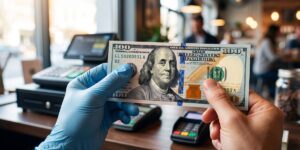
Imagine this. You are selling an old phone at a garage sale. A buyer hands you cash, you glance at it, and it looks fine at first. Or maybe you work at a busy store, and during a rush, someone pays with a large bill. You do not have much time to think, so you accept it and move on. Later, you start to wonder whether the bill was real.
That is exactly why this topic matters.
Fake bills can look very convincing at first glance. Many people expect counterfeit money to look cheap or obvious, but that is not always true. Some fake bills are easy to spot, while others only show warning signs when you slow down and check the details. In a fast transaction, it is easy to miss those clues.
The good news is that you do not need special training to catch many fake bills. In most cases, a careful look, a quick touch test, and a few simple comparisons can tell you a lot. The key is knowing what to check and not relying on only one sign.
In this guide, you will learn how can you tell if money is fake by looking at visual signs, feeling the texture, checking built-in security features, and understanding what to do if a bill seems suspicious. You will also learn common mistakes people make, which bills are often targeted, and how businesses can lower their risk.
This article is meant for everyday use. It is not a forensic test or a legal ruling. Currency features can vary by country and by bill design, but the basic checking process stays very similar. If you handle cash often, these habits can help you spot problems faster and protect yourself with more confidence.
What Does Fake Money Mean?
Fake money is also called counterfeit money. In simple terms, it means cash that is made to look like real currency even though it is not genuine. The goal is to trick a person or business into accepting it as real money.
A counterfeit bill may copy the size, color, portrait, and layout of a real bill. At first glance, it may seem normal. But when you look closer, the differences often start to show. The paper may feel wrong. The print may look blurry. The security features may be missing or poorly copied.
It is also important to know that not every US Dollar suspicious bill is obviously fake. Some counterfeit bills are crude and easy to catch. Others are made to pass a quick visual check. That is why people often ask, how can you tell if money is fake, especially when they are handling cash during a busy moment.
Another point to remember is that an unusual bill is not always counterfeit. Real currency can become worn, faded, torn, stained, or damaged over time. Older notes may also look different from newer ones. So the goal is not to reject every bill that looks imperfect. The goal is to check several signs together before deciding that something is wrong.
A smart approach is to stay calm and use a process. Do not judge a bill based on one detail alone. Instead, check how it feels, how it looks, what security features it has, and how it compares with a bill you know is real. When several things seem off at the same time, that is when concern becomes more justified.
How Can You Tell If Money Is Fake? Top Signs to Check
If you want the most practical answer to how can you tell if money is fake, start with a simple rule: check more than one feature. The best results come from combining touch, sight, and comparison.
1. Feel the Texture of the Paper
One of the fastest ways to check a bill is to feel it.
Real bills usually have a distinct texture that feels different from normal printer paper or notebook paper. Genuine currency often feels firmer and slightly rough because of the materials used and the way the bill is printed. It does not usually feel soft like copy paper, overly slick, or strangely waxy.
People who handle cash often notice this first. Even how to check for counterfeit money before they study the design, they notice that the bill does not “feel right.” That reaction matters. Texture is one of the most useful early clues.
A counterfeit bill may feel too smooth, too flat, too thin, or too stiff. Sometimes it feels like regular paper. In other cases, it may feel unusually thick because the fake material is poor quality. Any of those can be warning signs.
Still, use caution. A real bill that has been in circulation for a long time can feel worn down. It may be softer than a newer bill. That is why texture should be your first check, not your only check.
A good habit is to handle real cash carefully and pay attention to how genuine notes feel. The more familiar you are with real money, the easier it becomes to notice when something is off.
2. Look at the Printing Quality
Real money is printed with very sharp detail. Fine lines are clean. Small text is clear. The portrait, borders, and patterns are usually crisp and well defined. Even tiny design elements tend to look precise.
Fake bills often fail here.
If the printing looks blurry, smudged, washed out, or uneven, that is a major warning sign. Watch for faded colors, thick lines, fuzzy edges, or areas where the How to check if money is real ink seems to bleed. The design on a fake bill may look “close enough” from a distance, but poor quality often shows up when you look closer.
Pay extra attention to small features. Tiny letters, thin lines around the portrait, and detailed border patterns are often hard for counterfeiters to copy well. These areas may look muddy or broken on a fake bill.
Lighting also matters. If possible, check the bill under decent light rather than in a dark room or at a crowded counter. Good lighting makes weak printing much easier to spot.
If the bill looks dull, soft, or slightly out of focus, do not ignore that feeling. Real currency is designed with detail for a reason. When the print quality looks poor, it often means the bill deserves a closer check.
3. Check the Color-Shifting Ink
Many modern bills use color-shifting ink on certain parts of the design. This means a printed element, often a number, changes color when you tilt the bill and move it under light.
This is a helpful feature because it is hard to copy well with ordinary printing methods. A real bill may shift from one shade to another as the angle changes. A counterfeit version may stay flat, dull, or unchanged.
To test this, hold the bill and slowly tilt it back and forth. Do not just glance once. Move it under light and watch whether the printed area changes color in a smooth, natural way.
If nothing changes, that does not automatically prove the bill is fake, because features vary by country, denomination, and series. But if the bill should have color-shifting ink and it clearly does not, that is a strong sign to be cautious.
This check works best when you combine it with the others. Think of it as one part of a bigger screening process. If the paper feels wrong, the print looks weak, and the color shift is missing, the chances of a fake bill become much higher.
4. Hold It Up to the Light
This is one of the most reliable quick checks.
Many real bills include built-in security features that become easier to see when you hold the note up to the light. Two common examples are a watermark and a security thread. These features are usually part of the bill itself, not just something printed on the surface.
A watermark often appears as a faint image within the paper. A security thread is usually a thin strip embedded in the note. If the bill should have these features and they are missing, poorly placed, or look printed on instead of built in, that is a serious red flag.
This test matters because counterfeiters may copy the general design of a bill but fail to reproduce hidden features accurately. A fake watermark may look flat. A fake thread may look like a printed line instead of something inside the paper.
If you are checking cash from a specific country, it helps to know what genuine notes from that currency are supposed to include. Still, even without expert knowledge, you can often spot the difference between a real embedded feature and a poor imitation.
When people ask how can you tell if money is fake, this is often one of the best answers: hold it to the light and check what is built into the bill, not just what is printed on top.
5. Compare It to a Real Bill
When in doubt, compare.
A side-by-side comparison with a bill you know is genuine is one of the easiest and most effective ways to spot a counterfeit note. Many differences that are easy to miss on their own become obvious when two bills are placed next to each other.
Look at the color first. Does one bill look too dark, too pale, or slightly off in tone? Then compare size and shape. Counterfeit bills may be a little too large, too small, or cut unevenly.
Next, compare the portrait, spacing, numbers, borders, and alignment. Real bills are made with strong consistency. On a fake bill, the portrait may look strange, the margins may be uneven, or the printed elements may sit slightly out of place.
Also compare thickness and texture. Even before you study the design, your fingers may notice that one bill feels different from the other.
This method is especially useful for cashiers, small business owners, and anyone taking payments in person. A quick comparison can save a lot of trouble, and it takes very little time once you get used to doing it.
If a bill looks close but not quite right, trust the comparison. Small differences matter more than most people think.
6. Look Closely at the Serial Numbers
Serial numbers can reveal more than people expect.
On a real bill, serial numbers are usually consistent in style, spacing, color, and alignment. They should look neat and intentional. If the numbers appear crooked, mismatched, uneven, or printed in the wrong style, that can be a sign that the bill is fake.
Another red flag is when serial numbers look different from other printed elements on the note. For example, if the bill appears well printed overall but the serial number looks strange, the note deserves more attention.
One especially serious warning sign is seeing identical serial numbers on multiple bills in the same batch. Genuine notes are not meant to circulate with repeated numbers in that way. If two or more bills appear to share the same serial number, that should raise immediate concern.
That said, serial numbers alone are not enough to confirm a bill is counterfeit. Some fake notes may copy them neatly, while some real notes may look worn. Use this check together with the others. If the paper feels wrong, the print is poor, and the serial numbers look odd, the pattern becomes much stronger.
Small details are often what expose a fake bill. Serial numbers are one of those details.
7. Watch for Raised Printing
Real bills often have slight texture in printed areas. This is sometimes called raised printing. You may be able to feel it by lightly running your finger across certain parts of the bill, especially around the portrait or key text areas.
Counterfeit bills often feel flat because they do not use the same printing process. The design may look fine from a distance, but the surface can feel too smooth when you touch it.
This is a useful test because it is fast and does not require a special tool. A careful touch can reveal more than a quick glance. If the bill feels like a flat printed image rather than real currency, that is worth noticing.
Again, age matters. An older real bill may have less obvious texture than a crisp new one. But even then, genuine notes often keep some sense of structure and firmness. A fake bill may feel lifeless by comparison.
Raised printing is one more reason why handling real cash helps build your judgment. The more often you feel genuine currency, the more quickly you will notice when a note lacks the right texture and depth.
8. Inspect the Borders and Fine Details
Counterfeit bills often struggle with detail work.
Real currency usually has crisp borders, sharp patterns, and very fine line work. The edges of the design look clean, and the small decorative elements around the portrait and margins are usually precise.
Fake bills may show broken lines, blurred borders, uneven edges, or bleeding ink. These flaws can be small, but they are often consistent once you begin to look for them. A border that should be clean may appear fuzzy. Fine patterns may look thick or messy. Tiny design sections may lose their sharpness.
This is one reason a magnifying glass can be useful in some workplaces, but you do not always need one. Even with the naked eye, many fake bills reveal weak detail if you take a moment to inspect them closely.
Pay attention to symmetry too. Real bills are designed carefully. When lines look crowded, spacing looks off, or patterns do not match from side to side, that can be a clue that the bill was copied badly.
If you are checking cash in a store or at an event, this step may only take a few seconds. Once you learn what genuine detail looks like, poor copies become easier to catch.
9. Use a Counterfeit Detection Pen or UV Light
Tools can help, but they should never replace careful checking.
A counterfeit detection pen is often used to test whether a bill is printed on the wrong type of paper. A UV light can help reveal certain security features that appear under ultraviolet light on many modern notes. These tools are useful, especially in businesses that handle cash every day.
But they are not perfect.
A pen may only test one aspect of the bill. A UV light may only help if you know what feature you are looking for. A bill can pass one test and still be suspicious in other ways. That is why it is risky to rely on a tool alone.
The best approach is to treat tools as support, not proof. Use them together with visual checks, texture checks, and a quick comparison. If a bill feels wrong and looks wrong, do not let a single tool override your judgment.
For business use, a UV light or detection pen can make screening faster. For personal use, even simple habits like checking the paper, print quality, and built-in features can go a long way.
So, how can you tell if money is fake? Usually not from one magic trick. You tell by stacking clues together until the bill either looks normal or clearly does not.
Common Mistakes People Make When Checking for Fake Money
Many people miss counterfeit money for one simple reason: they rush. Most fake bills are accepted during fast, distracted moments. That is why a few common mistakes show up again and again.
The first mistake is relying only on a counterfeit pen. Pens can be helpful, but they are not complete answers. If you skip the feel, the print quality, and the light test, you may miss other warning signs.
The second mistake is checking only one feature. A bill might feel normal but still have poor printing. Or it may look sharp but lack the correct security feature. Real screening means checking several things, not just one.
The third mistake is accepting damaged bills without comparison. A worn bill is not always fake, but damage can make a suspicious bill easier to excuse. If you are unsure, compare it with a genuine note instead of guessing.
The fourth mistake is assuming small bills are always real. While higher-value notes often attract more counterfeit attempts, lower denominations can still be faked. Some people use smaller fake bills because they expect less scrutiny.
Another mistake is poor lighting. A rushed glance under dim light is not enough for a reliable check. Whenever possible, move to better light and take a second look.
Finally, many people ignore their first instinct. If a bill feels strange or looks off, do not dismiss that reaction too quickly. Your attention to detail is one of your best tools.
Which Bills Are Most Often Counterfeited?
In general, higher-value bills tend to attract more counterfeiting because they offer a bigger reward for the person trying to pass them. A fake large bill can buy more goods, more change, or more trust from a hurried seller.
That said, smaller bills can also be counterfeited. In some situations, lower denominations may actually pass more easily because people check them less carefully. A person handling cash all day may inspect a large bill closely but barely glance at a smaller one.
So the real answer is not to focus only on one denomination. The better habit is to stay alert with any bill that feels unusual, especially during in-person sales, busy checkout periods, events, flea markets, parking lots, or peer-to-peer transactions.
Patterns can also vary by country, region, and time period. Some notes stay in circulation longer. Some are used more often in street-level cash transactions region. Others are checked more carefully because people already know they are targeted.
The safest rule is simple: do not assume a bill is real just because its value is low. Counterfeiters often depend on people making that exact mistake.
What Should You Do If You Think Money Is Fake?
If you think a bill may be fake, do not try to spend it. Passing suspicious money to someone else can create more problems and may expose you to legal risk.
Instead, stay calm. Avoid folding the bill back into your cash or handing it to another customer. Keep it separate from genuine money so it does not get mixed in. Try to handle it as little as possible.
If you are in a business setting, follow your company policy. That may mean alerting a manager, documenting the time and situation, and contacting the proper authority or banking channel. If you are a private seller, your next step may depend on the setting and your safety.
Do not accuse someone aggressively if you are not sure, especially in a public or tense environment. Safety comes first. If the person who gave you the bill is still there and you feel safe, you can calmly say that the bill needs to be checked and ask for another form of payment. If the situation feels unsafe, focus on protecting yourself and contact the proper authority afterward.
You can also contact your bank or the appropriate local reporting channel for guidance. Procedures vary by location, so it helps to know the rules in your area.
The most important part is this: do not ignore a suspicious bill and do not try to pass the problem to someone else. Separate it, document what you can, and follow a proper process.
How Businesses Can Protect Themselves from Fake Money
Businesses that handle cash need systems, not just instincts.
The first layer of protection is employee training. Staff should know how to do a quick but effective check. That means feeling the paper, checking the print quality, looking at basic security features, and comparing suspicious notes when needed. Training does not have to be long or complex. Short, repeatable steps work best.
The second layer is having the right tools at the register. A counterfeit detection pen or UV light can help speed up screening. Good overhead lighting also matters more than many businesses realize. It is easier to miss a problem when the register area is dim or cluttered.
The third layer is a clear policy for larger bills. Many businesses choose to check high-value notes more carefully or require manager approval for certain cash payments. The exact rule depends on the business, but consistency matters.
Another smart habit is keeping a known genuine bill nearby for comparison. A quick side-by-side check can reveal differences in seconds. This is useful during busy times when staff may not have time for a long inspection.
Businesses should also create a standard response for suspicious money. Staff should know who to call, where to place the bill, how to document the incident, and how to speak to the customer calmly. A clear process reduces mistakes and helps employees feel more confident.
In the end, prevention works better than guesswork. When employees know what to look for and what to do next, the risk drops.
FAQs
Can fake money feel like real money?
Sometimes, yes. A counterfeit bill can feel close enough to real money to fool someone during a quick transaction. That is especially true when the person is distracted or unfamiliar with how genuine bills normally feel.
Still, texture differences often show up when you slow down. Real bills usually have a distinct feel because of their material and printing process. A fake bill may feel too smooth, too thin, too soft, or too stiff. It may also lack the slight texture found in raised printing.
That is why touch should be one part of your check, not the whole test. If a bill feels normal but the print quality is poor or the security features are wrong, it can still be counterfeit.
Is a counterfeit pen enough to detect fake bills?
No. A counterfeit pen can help, but it should not be your only test.
A pen usually checks only one factor, often related to the paper. That can be useful, but it does not confirm everything about a bill. A suspicious note may still look wrong, feel wrong, or fail security feature checks even if the pen result seems normal.
The best way to use a pen is as one step in a larger process. Pair it with visual checks, texture checks, and light checks. Think of it as a tool, not a final answer.
What is the fastest way to tell if money is fake?
The fastest method is to check several key features at once.
Start by feeling the paper. Then look at the print quality. After that, hold the bill up to the light to check for built-in security features such as a watermark or security thread if the note should have them. If you still feel unsure, compare it to a bill you know is real.
This multi-check method works better than relying on a single trick. It only takes a few seconds once you build the habit, and it greatly improves your odds of catching a fake bill.
Can small bills be fake too?
Yes. Any denomination can be counterfeited.
Higher-value bills often get more attention because they offer more profit, but smaller bills can still be used to trick people. In fact, lower denominations may slip by more easily because people do not check them as closely.
That is why it is risky to assume that a small bill is safe just because its value is low. If something about it feels or looks unusual, take a closer look.
Final Thoughts
You do not need expert training to spot many fake bills. In most situations, a careful person can catch obvious warning signs by checking the paper, the print quality, the built-in security features, and the overall look of the note.
The most important habit is not relying on one test alone. A counterfeit pen is not enough. A quick glance is not enough. Even a bill that looks decent at first can still be suspicious once you hold it, tilt it, or compare it to a real one.
If you remember one practical takeaway from this guide, make it this: the more familiar you are with real money, the easier it becomes to spot fake money. Real bills have a look and feel that becomes easier to recognize over time. Once you know that standard, suspicious notes stand out faster.
So the next time you ask, how can you tell if money is fake, the answer is simple. Slow down, check several features, trust clear warning signs, and follow a proper process if something seems wrong.

